Thursday, October 08, 2015

Words Rewriting Method in Syllogism


Words Rewriting Method in Syllogism
Armahedi Mahzar (c) 2015

In my last blog it was shown that we can derive the conclusion all valid syllogism as it is tabulated by Leibniz, using rewriting rules for the combination of the premises which are codified with alphabets as it was done by medieval logicians. However, the alphabetic codifications has the same pattern as the English sentences of categorical proposition of Aristotle  .

Asp is the code for “all s is p”
Esp is the code for “no s is p” or “all x is not p”
Isp is the code for “some s is p”
Osp is the code for “some s is not p”

So, it seems that the rewriting rules can also be translated to the verbal formulation.

R1. Commutation: Exchange sequence of  premises
R2  Transposition: “all x is y” = “all not y is not x”        
R3. Conversion:
       “all x is not y = “all y is not x” (Exy = Eyx) and
       “some x is y” = “some y is x”    (Ixy
= Iyx)
R5. Deletion of “x all x is” or “not x all not x is”

For example the premises combination of Barbara is “all s is m and all m is p”. If we delete the words “m and all m is” from it we get “all s is p” which is nothing but the conclusion.

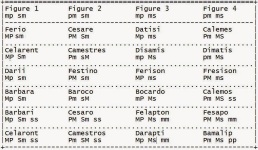
For other valid syllogisms we can also use the four rules selectively so the mid terms are in the middle of the premises conjunction and then we apply the fourth rule to get the conclusion of the syllogisms. The following table will help us to do such words rewriting: 


For example for the Darapti syllogism, it is done like this
“all m is p and all m is s and some m”
is rewritten following commutation rule R2 as
“some m is m and all m is s and all m is p”
that can be rewritten following deletion Rule R4 as
“some m is s and all m is p”
that can be rewritten following conversion rule R3 as
“some s is m and all m is p”
that can be rewritten following deletion rule R4 to get
“some s is p”
which is nothing but the conclusion of Darapti.

Another example is getting the conclusion of Felapton
“all m is not p and all m is s and some m is m”
is rewritten following commutation rule R1 as
“some m is m and all m is not p and all m is s”
which can be deleted (R4) to get
“some m is not p and all m is s”
which can be converted (R3) to get
“some not p is m and m is s”
which can be deleted (R4) to get
“some not p is s”
which can be converted (R3) to get
“some s is not p”
which is nothing but the conclusion of Felapton.

Afternote

It is a surprise that finally I discover a verbose method after a long exploration of algebraic (Brownian, Brickenian and Kauffmanian),  arithmologic (Boolean, Peircean and Sommersian) and combinatorics methods with formulas (Ploucquetian) and combinatorics games of things that I discovered, when in fact I was starting the journey ignited by my incomprehension of verbose formulation of logic by Aristotle. It turns that my journey is actually a circle.

However, my verbose method differs from Aristotle method of reducing all syllogisms to the perfect syllogism as the necessary syllogism which are true by themselves. My method is a reduction of the premises to the conclusion using rewriting rules. I have never seen before that the rewriting rules is also useful for a deduction in syllogistic.

All my methods can be simulated into a game of things, including the alphabetic and words rewriting method by replacing alphabets in a string, and words in a sentence, into different kinds or color of duplicate things such as colored beads in a chain.

Later on, I will present you such chains of colored beads, but firstly I like to examine other rewritten methods on the strings of alphabets and non-alphabetic  as it is implicit in historical systems of logic. That issues I will discuss in my following blogs.

Wednesday, October 07, 2015

Game of Life

Game of Life

John Horton Conway John Horton Conway at Princeton University in 2009. is is a British mathematician active in the theory of finite groups, knot theory, number theory, combinatorial game theory and coding theory. He has also contributed to many branches of recreational mathematics, notably the invention of the cellular automaton called the Game of Life.


Conway was interested in a problem presented in the 1940s by mathematician John von Neumann, who attempted to find a hypothetical machine that could build copies of itself and succeeded when he found a mathematical model for such a machine with very complicated rules on a rectangular grid.

The Game of Life emerged as Conway's successful attempt to drastically simplify von Neumann's ideas. The game made its first public appearance in the October 1970 issue of Scientific American, in Martin Gardner's "Mathematical Games" column.

From a theoretical point of view, it is interesting because it has the power of a universal Turing machine: that is, anything that can be computed algorithmically can be computed within Conway's Game of Life.[2][3] Gardner wrote:
The game made Conway instantly famous, but it also opened up a whole new field of mathematical research, the field of cellular automata ... Because of Life's analogies with the rise, fall and alterations of a society of living organisms, it belongs to a growing class of what are called "simulation games" (games that resemble real life processes).
The earliest interesting patterns in the Game of Life were discovered without the use of computers. The simplest static patterns ("still lifes") and repeating patterns ("oscillators"—a superset of still lifes) were discovered while tracking the fates of various small starting configurations using graph paper, blackboards, physical game boards (such as Go) and the like.

During this early research, Conway discovered that the R-pentomino     failed to stabilize in a small number of generations. In fact, it takes 1103 generations to stabilize, by which time it has a population of 116 and has fired six escaping glidersGame of life animated glider.gif   (these were the first gliders ever discovered)

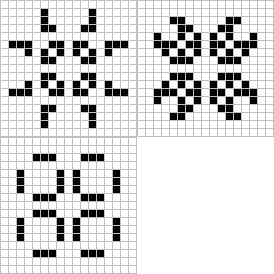
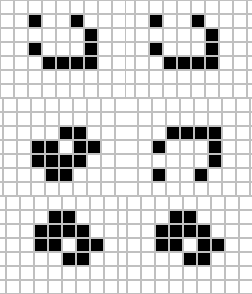
Many different types of patterns occur in the Game of Life, including
  1. still lifes  (block Game of life block with border.svg, ,
     
  2. oscillators (period 2 beaconGame of life beacon.gif , period 3 pulsar Game of life pulsar.gif,  period 15 pentadecathlon   I-Column.gif ) and 
  3. patterns that translate themselves across the board   called "spaceships" (glider Game of life animated glider.gif,  lightweight spaceship Game of life animated LWSS.gif ). 
 Conway originally conjectured that no pattern can grow indefinitely—i.e., that for any initial configuration with a finite number of living cells, the population cannot grow beyond some finite upper limit. In the game's original appearance in "Mathematical Games", Conway offered a $50 prize to the first person who could prove or disprove the conjecture before the end of 1970.

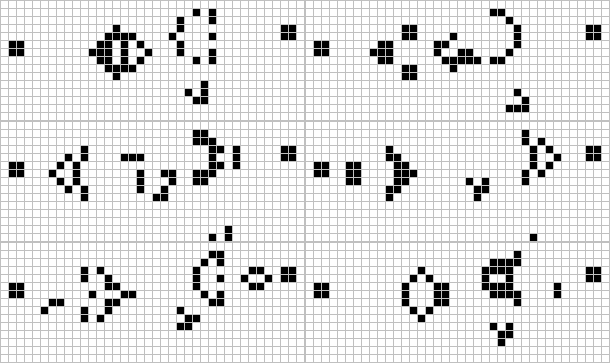
The prize was won in November of the same year by a team from the Massachusetts Institute of Technology, led by Bill Gosper; the "Gosper glider gun" Gosper_glider_gun_with_grid
  produces its first glider on the 15th generation, and another glider every 30th generation from then on. For many years this glider gun was the smallest one known.[19]

However, on April 28, 2015, Michael Simkin found a 36 cells  Simkin glider gun  http://www.conwaylife.com/w/images/c/cf/Simkinglidergun.gif 
as the smallest glider gun ever found. 


Penrose Tilings

Penrose tilings

A while ago, Roger Penrose  Roger Penrose, photographed at the university of Oxford. circa March ... famously filed a lawsuit against Kimberly Clark when his wife discovered that a roll of quilted lavatory paper was adorned with his aperiodic tiling. Although the tiling occurs naturally in quasicrystals, Penrose was probably the first person to discover and abstractly formalise the pattern. Nevertheless, there have been several historical ‘near-misses’ which came close, and indeed would have yielded isomorphic tilings if applied recursively. Since we’ve already mentioned Penrose, it seems only natural to approach this in inverse chronological order.

Kepler’s monsters

It is unknown as to exactly why Johannes Kepler Johannes Kepler 1610 investigated this particular tiling, although one sensible suggestion is that he was trying to construct a tiling of the plane involving only shapes with D10 symmetry. For example, ten regular pentagons neatly fit around a regular decagon of the same edge length, and it is possible to continue the pattern further if pentacles are also allowed:
kepler-fragment
Unfortunately, however, it is not possible to continue this process forever. Pretty soon one is required to have decagons overlapping, as in this particular drawing by Kepler:

Kepler’s original drawing of the Kepler’s Monsters tiling.
With the assistance of these fused decagons, termed monsters by Kepler, it is possible to create various periodic and nonperiodic tilings of the plane. Craig Kaplan explored many variations on this theme in his article, with the Keplerian problem of finding a tiling using only (finitely many distinct) shapes of D10 symmetry remaining unsolved.

Even earlier were several attempts by Albrecht Dürer, whom you may know from his Melencolia I engraving inter alia. These featured pentagons and rhombi, similar to Penrose’s original tiling but with less sophisticated matching rules incapable of enforcing aperiodicity.

Girih tiles

I was in the Persian section of the Victoria and Albert Museum during the post-Christmas weekend at the end of last year, and happened to notice various geometric designs. Some of these were periodic carvings of knotwork, not unlike similar examples in the Alhambra in Moorish Spain.

VLUU L200  / Samsung L200
Others were more exciting. One particularly ornate example features angles commensurate with the internal angles of a pentagon, and bears a striking similarity to the aforementioned tilings of Penrose, Kepler and Dürer:


VLUU L200  / Samsung L200

Apparently these are formed from a set of five so-called Girih tiles, and patterns of a similar nature occurred throughout the Islamic world since the Middle Ages. In particular, I am intrigued to see the more sophisticated Girih tilings featuring patterns on two scales, where the small-scale pattern is created by applying a set of subdivision rules to the large-scale pattern. This is analogous to the method by which Penrose tilings can be constructed, as you will know from my online demonstration:
wieringa
This surprising and fascinating connection between Islamic architecture and quasicrystalline tilings was first discovered and investigated by Paul Steinhardt and Peter Lu, the latter of whom presented an exposition on the subject at the Harvard Physics Colloquium:


If you found this interesting, there is a talk on early Islamic mathematics by Dr. Bursill-Hall at 16:00 today in Meeting Room 3 of the Centre of Mathematical Sciences.

Dürer’s Magic square and Beyond

Dürer’s Magic Square and Beyond

In Albrecht Dürer’s 1514 engraving Melancolia I, there is a famous 4×4 magic square. In addition to the rows, columns and main diagonals summing to 34, so do various other arrangements such as the quadrants and four corners.


Binary Magic Square


We can transform this into an equivalent magic square by decrementing each of the values. This will map the numbers into the interval [0, 15] instead of [1, 16]. We can then write these values in binary as four-bit numbers.


Dürer’s magic square, in binary

Of course, Dürer wouldn’t have done this as binary was unknown to Western civilisation at that time (Gottfried Leibniz was born more than a century later). You may begin to notice patterns in the binary square. These become much more evident when we separate it into ‘layers’.
The four 'binary layers' of Dürer's magic square
The four ‘binary layers’ of Dürer’s magic square
Consider each layer separately. Each row, column, diagonal and any of a plethora of other arrangements (such as 2×2 ‘blocks’ in the corners) contains precisely two black and two white squares. This means that the sum must be equal to 2(1+2+4+8) = 30 in each of these arrangements. Since we decremented the values to obtain this square, the corresponding sum in Dürer’s original square is 34.

Magic Cube


Remarkably, someone has found a magic cube containing Dürer’s square as a subplane. However, the numbers are not {1, 2, …, 64}, so it is of questionable validity. We can instead exploit the binary construction to yield a true magic cube with the numbers {1, 2, …, 64}. First, it is necessary to understand precisely what is happening in each of the binary bit planes.
Creating a bit plane using the XOR operation
We can construct the first bit plane by applying the exclusive or (XOR) operation to two ‘orthogonal’ patterns. If each of these orthogonal patterns contains two rows/columns (which they do!), then every row and column in the combined pattern must contain precisely two black and two white squares.
For the cube construction, we have to XOR together three orthogonal pairs of planes. We’ll choose planes which appear to generalise the two-dimensional counterparts, resulting in six ‘bitspaces’, two of which are shown below:
Three-dimensional generalisations of the Dürer bitlayers

These two ‘bitspaces’ are linearly independent of each other and the other four bitspaces obtained by rotating them about a long diagonal. Hence, they together generate a magic cube related to Dürer’s square, where every orthogonal line has a sum of 130. Note that the four diagonals each pass through two cubes of each bitspace, so the diagonals (or, more generally, any centrally symmetric arrangement of four cubes) of the magic cube also have the same sum of 130. Additionally, selecting four out of the eight corner cubes (such that they form a regular tetrahedron) gives the sum of 130.

Dürer cube
Three-dimensional generalisation of Dürer’s magic square

Magic Hypercube

In fact, we can construct a 4x4x4x4 magic tesseract using this technique, and so on ad infinitum.
Dürer's tesseract
Dürer’s tesseract
Amusingly, this visualisation of the tesseract is also a 16×16 magic square!

source

Saturday, October 03, 2015

Easy to learn syllogism

Easy to Learn Syllogism
Armahedi Mahzar (c) 2015
  • Last night I woke up and saw formulas of both premises of a syllogism flying in front of my eyes, merging and retracting concluded with a very simple way: eliminate xAx.
    -
    Syllogistic inference

    Example: Barbara IF Aab AND Abc THEN Aac. Combining Aab and Abc we get AabAbc. If we remove bAb, then Aac is staying and that is the conclusion.

    For the syllogism that involves negative statements E also done the same thing, if Exy is rewritten as AxNy, where Nx means NOT x. Meanwhile IxNy in the conclusion is rewritten as Oxy.

    Examples for figure-1 syllogism:

    Barbara: Abc Aab = Aab Abc = Aac
    Celarent: Ebc Aab = AbNc Aab = Aab AbNc = AaNc = Eac
    Darii: Abc Iab = Iab Abc = Iac
    Ferio: Ebc Iab = Iab Ebc = Iab AbNc = IaNc = Oac
    Barbari: Iaa Aab Abc = Iac
    Celaront: Iaa Ebc Aab = Iaa AbNc Aab = Iaa Aab AbNc = Ianc = Oac
    -

    Rules of Rewriting

    It turns out that syllogism can be solved with simple rules

    R1. Exchange sequence of  premises {AND commutativity}
    R2. Identities Exy = AxNy;  Oxy = IxNy           {definition}
    R3 Axy=ANyANx                                         {transposition}
    R4. Identity Exy = Eyx and IXY = Iyx {simple conversion}
    R5. Deletion of x Ax

    The proofs of the validity of all syllogistic mood are shown in the following table


    A Reflection

    1. Then I felt so stupid. You see, I have long been aware of the formulas A, E, I and O of the medieval logicians. Those formulas  are useful to me, because it made me able to prove the validity of the 24 syllogism in the Leibniz table using three consequences in the form algebra of George Spencer-Brown.


    2. The rewriting method can also be simulated by the linear game of things. In this game, each letter in the string of alphabets is replaced with a chain of colorful objects. Hopefully I will present it in my next blog.

Wednesday, September 30, 2015

Steps toward Holologics

Steps toward Holologics

Armahedi Mahzar (c) 2015

For me, a physicist, the simplicity of physics is its beauty. For example, when we want to describe the motion of all objects, on earth or in heaven, we simply use Newton’s three laws of motion only + the law of gravity. For me it’s as beautiful as the fact that to explain so many geomtric facts , we only need just six axioms. The beauty of this geometry in junior high I get when axiomatic geometry is still taught as a subject.In the 19th century when George Boole  boole  finally formulate logic as an algebra based on a very simple arithmetic based only two numbers, 0 and 1. With this new formulation, the verbal Aristotelian syllogism in logic  is merely a special case of logical tautology. But I still wonder: how many are the axioms of logic algebra.

The problem is, what is the axiom basis of logic and how many? The formal foundations of mathematics are called axioms. For example, Euclidean geometry is built on the basis of just six axioms. That is why in the past, when I was a university student, when I learn that the propositional calculus of Whitehead whitehead-Russell russell, in his Principia Mathematica , built on five axioms and one rule of inference, I was so amazed. However, it turns out that my admiration is nothing. It is just the first step on the way to the highest admiration in the end phase of may journey to Boolean space as a part of the Platonic space of ideas.

When I became a lecturer in the 70s of last century, in the British Council library of Bandung, I found a book called “Laws of Form”, written by George Spencer Brown brown , Which was praised by Bertrand Russell as the greatest discovery in the field of mathematics, I was very interested. But then I am very disappointed, because I can not understand the strange formulas listed in the book. Unfortunately, later on, the book was missing from the library book shelves so that I could never read it again.

Fortunately, I was connected to the internet in 2000, when I was retired. In the internet, I found an electronic book titled “Laws of Form” by Louis Kauffman https://i0.wp.com/uni-phi.org/images/kauffman.jpg . From it, I know that the strange formulas in the Spencer-Brown book of the 70s actually are the algebraic equations in the Boolean logic in an unconventional notation. Later on, I reformulated Brownian algebra in a box algebra with colored balls: Objective primary algebra
I was so excited to know the fact that Spencer-Brown managed to cut the number of axioms of Russell-Whitehead to just two. For me, this means that mathematical logic is much more beautiful than geometry. This fact truly amazed me, because the Boolean algebra of logic is only based on a pair of axioms. At the end of this article I’ll show you that the basic axioms of algebraic logic is not two, but one that is 1. Please follow my journey towards this ultimate truth.

Axiomatic Unity of Logic

When I discovered that there is a double foundation logic space, I asked: is the beauty of the logic ended there? Praise God, the logic was much more beautiful. You see, I found out later, Louis Kauffman managed to cut the number of axioms of algebraic logic. It only took a single axiom. But unfortunately, the axiom that when I first read it is not intuitive. Thankfully, in his book, Kauffman stated that the formulas Brown strange it can be read by two different meanings framework: disjunctively and conjunctively.

Within the framework of a disjunctive meaning, as adopted Spencer-Brown, the juxtaposition of two letters, which represent the two statements, considered as a merger of the two by OR. Within the framework of conjunction, as it is embraced by Charles Sanders Peirce, the juxtaposition was read as merging two statements by AND. If we merge disjunctively, VOID is read as a symbol for FALSE, while the incorporation of conjunctive merge, VOID is the epitome of TRUE.

When I read the single axiom Kauffman conjunctively, I immediately noticed that the single axiom is actually none other than the mathematical expression of an ancient principle, pre-Aristotle , Contradictio ad Absurdum   . The principle states that a statement is true if and only if the denial contradictory. It is very intuitive, because the principle that means: A IS TRUE  IF AND ONLY IF NOT A IS FALSE.

You can imagine how happy I was, when it discovered that modern algebra Boolean logic it turns out to be founded on an ancient logic principle has been known long before Aristotle formulated the science of logic. This fact shows that the basic logic is only one and this one turned out to be very intuitive. For me this is ultimately showing the beauty of simplicity of logic. Read Ultimate Simplicity of Logic

The Syllogistic Unity

However, my happiness was tainted because I was unable to derive the Aristotelian syllogism from Boolean algebra. The explanation Boole in his famous book was “Laws of Thought” on Aristotelian syllogism proves how completely beyond my comprehension because it is so complex. However, in the appendix to the book “Laws of Form” Spencer Brown describes a simple prove of the validity of the Aristotelian syllogism Barbara from algebra by using his strange notation.

Spencer-Brown even stated that the whole 24 varieties of valid syllogism can be proved in the same way. I do not know, what are the 24 varieties of valid syllogism. Fortunately, I finally found that out in an Wikipedia article about the syllogism. Over the years I unsuccessfully tried to prove that Brown’s statement. For that, fortunately, I was helped by a pictorial notation Kauffman symbolizing NOT operation with confinement in a BOX.

For ease of visualization. I replace the letters in algebra Box Kauffman with colorful balls. The new pictorial Algebra I call the object logic. Thanks God, by reading the box algebra of Kauffman as a game drawing and erasing pictures, finally I can attest to the validity of the 24 Aristotelian-Leibniz syllogism.
Even at the end, I can attest to the 24 valid syllogism was equivalent to each other. The fact that I refer to as the unity of syllogistic this made me even happier. You see, I find out that it has not been disclosed by others throughout my search on the Internet eith Google search engine. I reported my findings in a series of blogs that I then united in a ebook: Syllogistic Unity. Read Syllogistic unity

The Tautological Unity

However, the excitement does not last long, when then realized that it was trivial, because if a valid syllogism means he is equivalent to 1 or TRUE. Because everything is equivalent to one, then by itself all the valid syllogism equivalent to each other. However, this finding would indicate that all identities of Boolean logic or tautologies are actually equivalent to each other too. Because any valid syllogism is really just a tautology.

Discovery the greater tautological unity is, in fact, very surprising to me. You see, every system is axiomatic algebraic logic is complete as it can prove all tautologies or existing logical truth. Remarkably, all the logic tautology, in fact, can be derived from the axioms by simply using algebraic substitution rules. That is the unity of tautological truth is algebraic or mathematical.

This tautological unity indicates that the validity of the syllogism as a tautology, can also be actually derived from the principle of Contradictio ad Absurdum. Here’s the proof: a syllogism is true, if and only if its denial is false.

Denial of a syllogism called by Christine Ladd-Franklin, Peirce’s student who later became the first female Doctor of the United States in the field of natural science, as antilogism. So a syllogism is valid if only if its antilogism is false. That is indeed a valid syllogism can be derived from a single axiom Kauffman: contradictio ad absurdum. This fact encouraging my heart.

The Foundation of the Unity: 1

However, starting from the reference of Kauffman, I finally found out that Charles Sanders Peirce actually built a system of logic, namely The simple existential graph system, based on just one axiom as well. However, his axiom is much simpler than the principle of Contradictio ad Absurdum in its formulaic form a IF AND ONLY IF (IF NOT a THEN b) AND (IF NOT A THEN NOT b). TRUE is his only axiom and it is denoted by ZERO in the system of existential graphs. The principle of Contradictio ad Absurdum, which is the single axiom of Kauffman, is just a theorem in Peirce’s Existential Graph axiom system.
Peirce proved this with his 5 rules of logical inference which may be difficult to remember. I will prove it mathematically with the notation of Boolean NOT(x) = 1 – x, x AND y = x -1 + y and IF x THEN y = x-> y = 1 – x + y as follows:
1 = (1-a) -1 + (1 + a)                                                                    {because 1-1 = 0 and a-a = 0}
= (1-a-a + a) -1+ (1-a + a + a)                                                                              {from a-a = 0}
= (a + a-> a) AND (a + a -> a)                             {from the definition of x-> y and x AND y}
= (a + a = a)                                                                                    {from the definition x = y}
= ((a + b) -1+ (a + 1-b ) = a)                                                      {because 1-1 = 0 and b-b = 0}
= ((1- (1-a) + b) -1+ (1- (1-a) +1 -b) = a)                            {because – (- a) = + a and 1-1 = 0}
= ((NOT(a) -> b) AND (NOT(a) -> NOT(b)) = a)      {from the definition of x-> y and NO (x)}
= ((IF NOT(a) THEN b) AND (IF NOT(a) THEN NOT(b)) = a) {the translation of -> in words}
Because TRUE is 1, then the single axiom of Kauffman
(IF NOT(a) THEN b) AND (IF NOT(a)
THEN NOT(b)) = a,
formulated in the Box Algebra of Kauffman as
[[a] b] [[a ] [b]] = a,
is TRUE.

Conclusion and Aftermath:

If the Euclidean geometry requires 6 axioms, it turns out that the Boolean algebra necessitates only one single axiom axiom alone and it is 1 as it has been demonstrated above. Back then, after finising junior high school, I admired the beauty of Euclidean geometry that describes physical space, which is inhabited by the universe, that is based on 6 axioms.

Now, in my retirement, I am faced an extraordinary fact that the mental space, which is inhabited by our thoughts, is based on just one axiom: 1. This brought me an incomparable happiness because the universe is derived from the ABSOLUTE ONE in accordance to Tawheed, apparently of origin of the ideals is also a relative One. The relative One is just a shadow of the ABSOLUTE ONE. Allah Is The Greatest. Praise to the Lord of all the worlds.

OK, the lines above is modified reposting of my blog The Ultimate Unity of Logic
Discovering Arithmologic
It is subjectivelly religious since I am a muslim. However, further contemplation will also show that the ultimate foundation of logic is 0 (symbol of TRUE) in Peircean and Sommersian Arithmologic
The Ending: Combinatoric Game of Thing

Finally I simulated Sommersian arithmologic in the various combinatoric games of thing in series of blogs from Literal Combinatoric of Plouquet
to Holological Reflection
Thank you for following the trackback of my journey in logic.
Hopefully, you will join holologics@yahoogroups.com.