Monday, January 18, 2016

Varino Magic Square

Varino Magic Square

Armahedi Mahzar (c) 2016

In my last blog I presented a new kind of magic square built up from monominoes each containing 1 to 16 dots. In this blog I will present you another form of magic square  containing varinoes magic as its elements. A varino is a single dot monomino with the the color of the dot and the the color of the background are varied. What are the puzzles around varinoes ?

Varino Magic Squares

If we have 4x4 square, can we distribute all possible 4-colors varinoes such that the dot colors and its background colors are not repeated in the same row, column and diagonal?
The following is one of the possible solutions:
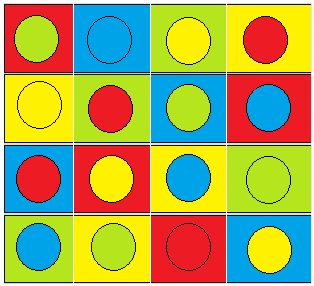
Color Greco Latin Square

Well, since every row column and diagonal has 4 different colored square and 4 different colored dots, they have the same set colored squares and the same set of colored dots, we will called the set pair as the magic set pair.

So, we have generalized the numeric magic square to a general magic square by replacing number with any similarly type element, and replacing the numeric addition with the set union. In this case the elements is the varinos.

Relation to Numeric Magic Square


In fact, the varino magic square is equivalent to numeric magic square, as it will be seen if we proceed the following replacement procedure:
If we replace
•    the red square by the numeral ‘0’ and the red dot by the numeral ‘0’
•    the blue square by the numeral ‘1’ and the blue dot by the numeral ‘1’
•    the green square by the numeral ‘2’and the green dot  by the numeral ‘2’
•    the yellow square by numeral ‘3’ and the yellow dot by the numeral ‘3’.
then we get the following numerical magic square


02 11 23 30
33 20 12 01
10 03 31 22
21 32 00 13

with the magic number 66 as the sum of all four numbers in any row, column and diagonal.
This numerical magic square can be transformed to the following numerical magic square

  2    5   11    12
15    8    6       1
  4    3   13    10
  9  14     0      7
with magic number 30, if we read the previous square as quaternary number base 4.
If we add 1 to every number in the last magic square, then we get the ordinary magic square of order 4

  3    6    12    13
16    9      7      2
  5    4    14    11
10  15      1     8

which isomorphic to the monominoes in the last blog


Afternote


In the next blog we will replace the varinoes with the combinoes which symbolize subsets of a set to get the combino magic square. This is another generalized magic square. Hopefully you will enjoy it as a mathematical recreation.

Tuesday, January 12, 2016

Unomino Magic Square

Unomino Magic Square
Armahedi Mahzar (c) 2015

A domino is two connected squares, each containing many dots or none. A unomino  is a single square containing dots like dominos. We can rearrange the little black square places so each column, row and diagonal is containing exactly the same numbers of dots to get


The unonimo magic square is isomorphic to the 3x3 magic square known as Lo Shu was discovered thousand years ago in the back of mythical turtle by Fuh-Shi,  the mythical founder of Chinese civilisation in around 2400 BC.


Before they invented the zero numeral, the Arabs used alphabets as the written symbols of numbers. Here is the 3×3 Magic Square


In fact there are bigger and bigger Magic Squares.

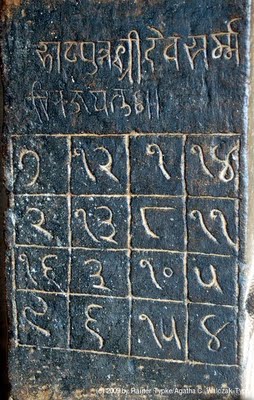
For example, the earliest 4X4 Magic Square is discovered in Khajuraho India dating
from the eleventh or twelfth century.


Later, another 4X4 Magic Square  was found in Albert Dürer’s engraving ” Melencolia”, where the date of its creation, 1514 AD. See it under the bell.


The previous nine monominoes is only part of larger set of monominoes containing dots from 1 up to 16. These are the sixteens monominos arranged is 4x4 square

monomino 4x4 aWe can rearrange the unominoes such that each column, row, diagonal and little 2×2 square is containing exactly the same number of dots. For example the following is the unomino magic square of order 4.
 
monomino magic square

This magic square  is wonderful. Because all the collumn. rows and diagonals are containing 34 dots. The 2×2 center square is also containing 34 dots. The dots in each corner 2×2 squares are 34.

This is only one solution of the Puzzle. The French mathematician Frenicle de Bessy   in 1693 enumerated the number of all possible 4×4 Magic Square and get the number  880. 

Sunday, October 25, 2015

Magic Square of the Sun

Magic Square of the Sun,
The Sun's I-Ching.


If you draw a line sequentially from 1 to 64 you will see the double pattern of the permutations of life, represented by each kua, in The Mayan Factor by Jose Arguelles. It is also called The Mind of the Earth, The Van Allen Belts, Psi Bank, Oversoul, World Soul of Plato, Psychic Bank and Sensorium of Harold.
This magic square pertains to life (I-Ching), not light (Tzolkin), 

torah.


If the Magic Square of 8 x 8, was found by the Mayans, to represent the mind of the earth, then the Sun, being a more massive, hence, more organized form, should be found to represent an even larger, more organized Magic Square as indicated in the 7 levels of Magic Squares in File, "14 Space Patterns".

If you will connect straight lines between each two numbers of this magic square, sequentially, beginning with 1, you will discover a very ornate, 3-part pattern that should describe the Suns 256 (16 x 16) mind permutations (I-Ching).

This 16 x 16 Magic Square corresponds to the 8 x 8 of the earth, therefore I concluded that it is embedded in what I call a Sun Tzolkin of unknown number. To find that number I divided the earth Tzolkin (260) by the I-Ching 64 (8 x 8) = factor 4.0625, then multiplied factor 4.0625 x 256 (16 x 16), the number of squares in the Sun Magic Square, representing the Suns I-Ching.

This gives 1040 squares in the Suns Tzolkin, but, upon taking the square root of 1040 I expected a round number like 32, 32 being the assumed next larger Magic Square (32 x 32), following the binary progression of nature namely 2, 4, 8, 16, 32, 64, but to get 32 as an expected number one has to take the square root of a lesser number, 1024, as the square root of 1040 = 32.24903.

Summary:
The square root of:
The I-Ching, 64, of the earth = 8
The I-Ching, 256, of the Sun = 16
The Tzolkin, 260, of the earth = 16.124515
The Tzolkin, 1040, of the Sun = 32.24903

So it seems these ratios following are appropriate to describe earth and Sun mind, remembering that the I-Ching is embedded within the Tzolkin:

64 : 260 :: 256 : 1040 or in words:
64, the earths I-Ching is to 260, the earths Tzolkin, as
256, the Suns I-Ching, is to 1040, the Suns Tzolkin.

Note that the number 52 does not occupy the precise center, but shares it with three other numbers, 77, 181 and 204 and is fractally involved with the Mayan 52 years, 5,200 year cycle and Bodes Law of Sun / Planet distances (5.2), for Jupiter.


200
217
232
249
8
25
40
57
72
89
104
121
136
53
168
185
58
39
26
7
250
231
218
199
186
167
154
135
122
103
90
71
198
219
230
251
6
27
38
59
70
91
102
123
134
155
166
187
60
37
28
5
252
229
220
197
188
165
156
133
124
101
92
69
201
216
233
248
9
24
41
56
73
88
105
120
137
152
169
184
55
42
23
10
247
234
215
202
183
170
151
138
119
106
87
74
203
214
235
246
11
22
43
54
75
86
107
118
139
150
171
182
53
44
21
12
245
236
213
204
181
172
149
140
117
108
85
76
205
212
237
244
13
20
45
52
77
84
109
116
141
148
173
180
51
46
19
14
243
238
211
206
179
174
147
142
115
110
83
78
207
210
239
242
15
18
47
50
79
82
111
114
143
146
175
178
49
48
17
16
241
240
209
208
177
176
145
144
133
112
81
80
196
221
228
253
4
29
36
61
68
93
100
125
132
157
164
189
62
35
30
3
254
227
222
195
190
163
158
131
126
99
94
67
194
223
226
255
2
31
34
63
66
95
98
127
130
159
162
191
64
32
33
1
256
225
224
193
192
161
160
129
128
97
96
65
source

Codon Anti-codon Magic Square

 CODON ANTI-CODON MAGIC SQUARE

  The original name was: "The sequence is an anti-diagonal of the decimal of a mapped 4-ary Gray code matrix as a triangular sequence."
  Gary W. Adamson's explanation of the sequence: Here's the conversion rules for the codons, 4-Ary gray code, which "turns out" to be the most appropriate format for mapping the Codons on a gray code Karnaugh map. The "why" this is the appropriate format relates to a degree of trial and error to find the proper fit in terms of the numbers of hydrogen bonds per codon- anticodon.

(Antti Karttunen's comment: obscure definition. The "degree of trial and error" should be defined transparently.)
  The "H-bond codon-anticodon magic square" map by Gary Adamson, published on page 287 of Cliff Pickover's book "Zen of Magic Squares..." looks like this:
  
CCC CCU CUU CUC UUC UUU UCU UCC
CCA CCG CUG CUA UUA UUG UCG UCA
CAA CAG CGG CGA UGA UGG UAG UAA
CAC CAU CGU CGC UGC UGU UAU UAC
AAC AAU AGU AGC GGC GGU GAU GAC
AAA AAG AGG AGA GGA GGG GAG GAA
ACA ACG AUG AUA GUA GUG GCG GCA
ACC ACU AUU AUC GUC GUU GCU GCC

Using the conversion rules:
0 = C, 1 = A, 2 = G, 3 = U,
we convert to 4-ary gray code:

 
000 003 033 030 330 333 303 300
001 002 032 031 331 332 302 301
011 012 022 021 321 322 312 311
010 013 023 020 320 323 313 310
110 113 123 120 220 223 213 210
111 112 122 121 221 222 212 211
101 102 132 131 231 232 202 201
100 103 133 130 230 233 203 200


To convert back to decimal:
 
+0 +3 14 15 58 57 62 63
+1 +2 13 12 59 56 61 60
+6 +7 +8 11 54 55 50 49
+5 +4 +9 10 53 52 51 48
26 25 30 31 32 35 46 47
27 24 29 28 33 34 45 44
22 23 18 17 38 39 40 43
21 20 19 16 37 36 41 42


... and that's it! Notice how the 1,2,3... jumps around, somewhat like a Peano curve, from one 4-unit cell to the next.
  Antti Karttunen's notes: The steps 1 & 2 are clear, but the step 3 would not produce the array given here, but instead the array A163239. Furthermore, in Pickover's book the conversion rules C=0, A=1, U=2, G=3 are used, in which case we get the array A163235


Also, the path taken by the terms does not form a continuous Peano curve (Hamiltonian path), because there are discontinuities, e.g. when going from 3 to 4, or from 15 to 16. See A163357/A163359 & A163334/A163336 for examples of continuous Peano/Hilbert curves/paths in an NxN grid. However, this sequence is uniquely defined by the formula a(n) = A163485(A057300(A054238(n))). The 8x8 array given at the step 3 is the top left corner of the infinite square array whose antidiagonal gives this sequence.

REFERENCES
Clifford A. Pickover, The Zen of Magic Squares, Circles, and Stars: An Exhibition of Surprising Structures across Dimensions, Princeton University Press, 2002, pp. 285-289.
 

source