Sunday, September 13, 2015

Combinatoric Logic Game of Cards


Combinatoric Logic Game of Cards
Armahedi Mahzar (c) 2015

In my previous blog it has been shown that the combination and disposal of pairs of colorful marbles with two condition can prove any valid syllogism tabulated by Leibniz by the lineal combinatoric of Ploucquet. The combinatoric verification process can be simulated by the game of arranging and disposing colored marbles with pieces of paper..

In the following it will be shown that we can also make the game arranging and disposing colorful cards with only two orientation. The secret is the fact that we can replace the changing the marble positions to represent the opposite concept in the last gamewith the changing of the card orientation in the new game.

Fundamental Categorical Proposition of Aristotle

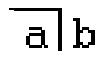
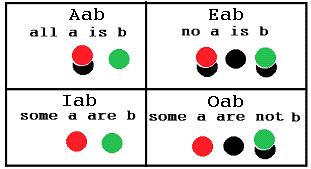
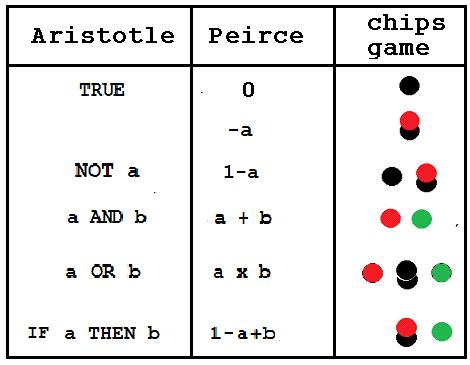
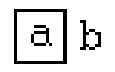
 ed the card , the its opposite NOT a is represented by the horizontally oriented card  .

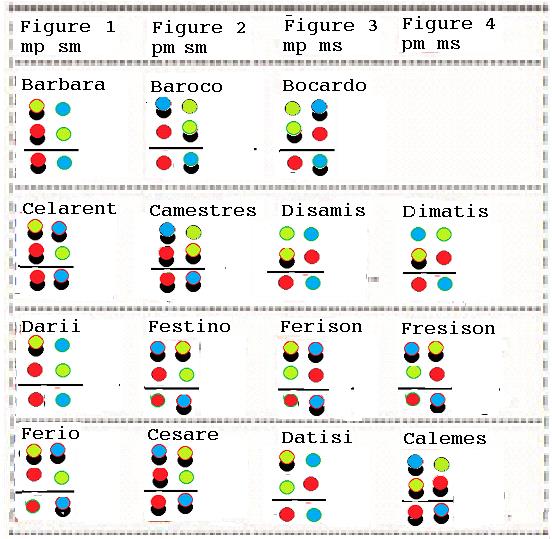
If the subject is represented by a red card and predicate b represented by green card , then the fundamental categorical statement of Aristotle is represented by pairs of cards  as it is shown in the following table


The premises and conclusion of a syllogism form is one of four such statements.

Proof of the Validity of Syllogism

The game playing that simulate the proving of the validity of a syllogism includes the following steps
 
  1. juxtaposing the card pairs which represent both premises of a syllogism
  2. disposing the pair of same colored cards with different orientation
  3. putting the card which represent the subject of the second premise as the card that represent the subject of the syllogism conclusion.

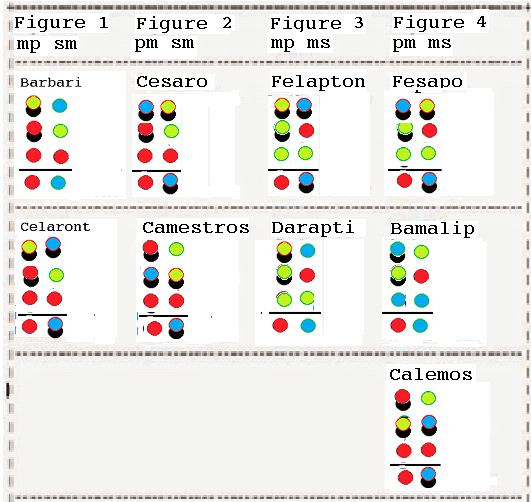
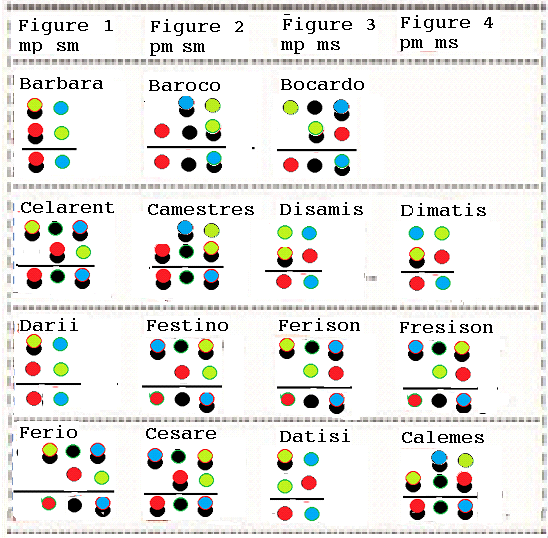
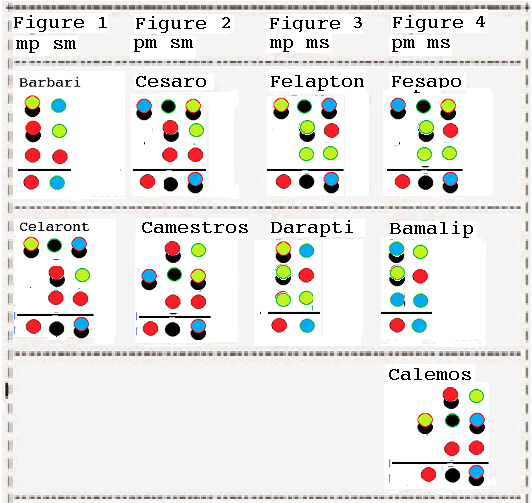
With a game like this, we can do the proving of valid syllogisms with ease, because the end result of the game is a representation of the syllogism by disposing pair(s) of opposite orientated
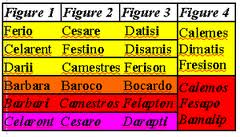
card of the same color  in the  Leibniz’s  table below:


End notes

    1. Apparently, the game is very simple using colored cards that it can be taught to kindergartners. The game can also be seen as a Sommersian arithmologic game.
    2. The cards can be replaced with anything that have duplicates with the help of one sheet of paper.

Monday, September 07, 2015


Combinatoric Logic Game of Marbles
Armahedi Mahzar (c) 2015

In my previous
blog it has been shown that the combination and disposal of parallel colorful sticks with two orientations can prove any valid syllogism tabulated by Leibniz by the lineal combinatoric of Ploucquet. The combinatoric verification process can also be simulated by the game of arranging and disposing colored marbles and pieces of paper.


In the following it will be shown that we can simulate logical proof with the game arranging and disposing  the colorful marbles and pieces of paper. The secret is the fact that we can replace the changing the line length to represent the opposite concept with the changing of the marble’s ground.


Fundamental Categorical Proposition of Aristotle


If the subject a is represented by a red marble   and predicate b represented by green marble  , then NOT a is represented by red marble placed upon small white paper  .

Furthermore, the fundamental categorical statement of Aristotle is represented by pairs of marbles as it is shown in the following table


The premises and conclusion of a syllogism form is one of four such statements.


Proof of the Validity of Syllogism


The game playing that simulate the proving of the validity of a syllogism includes the following steps


  1. juxtaposing the marble pairs which represent both premises of a syllogism
  2. disposing the pair of same colored marble with different ground
  3. putting the marble which represent the subject of the second premise as the marble that represent the subject of the syllogism conclusion.

With a game like this, we can do the proving of valid syllogisms with ease, because the end result of the game is a representation of the syllogism conclusion. The table below is the Leibniz table of the premises of valid syllogisms. 


End notes


  1.  Apparently, the game is very simple using colored marbles  can be taught to kindergartners. The game can also be seen as a simulation of Sommersian arithmologic.
  2. Unfortunately, this game can only be played with the help of additional pieces of paper.  However, with a set of colored cards without  the help of other pieces of paper, we can simulate the proving of the syllogism validity with a simpler game as I have found it. Hopefully, that will be presented in my next blog.

Saturday, September 05, 2015

Combinatoric Logic Game of Sticks

Combinatoric Logic Game of Sticks
Armahedi Mahzar (c) 2015

In my previous blog it has been shown that the combination and disposal of parallel colorful lines with two size can prove any valid syllogism tabulated by Leibniz by the lineal combinatoric of Ploucquet.
The combinatoric verification process can be simulated by the game of arranging and disposing colored lines of two lengths.

In the following it will be shown that we can also do it with the game of arranging and disposing the colorful sticks with only one size. The secret is the fact that we can replace the changing the line length to represent the opposite concept with the changing of the stick orientation.


Fundamental Categorical Proposition of Aristotle


If the subject is represented by a red upright stick and predicate b represented by green upright stick, then the fundamental categorical statement of Aristotle is represented by pairs of rods as it is shown in the following table

Stick Categorical Proposition

The premises and conclusion of a syllogism form is one of four such statements.


Proof of the Validity of Syllogism


The game playing that simulate the proving of the validity of a syllogism includes the following steps

  1. juxtaposing the stick pairs which represent both premises of a syllogism
  2. disposing the pair of same colored sticks with different orientation
  3. putting the stick which represent the subject of the second premise as the stick that represent the subject of the syllogism conclusion.

With a game like this, we can do the proving of valid syllogisms with ease, because the end result of the game is a representation of the syllogism conclusion that we can be compared to Leibniz’s conclusions in the table below:


End notes


1. Apparently, the game is very simple using colored sticks that it can be taught to kindergartners. The game can also be seen as a Sommersian arithmologic game.

2. Unfortunately, this game can only be played with elongated objects such as a stick, but not to objects of arbitrary shapes.

3. God willing, with the help of pieces of paper, the proving of the syllogism validity can also be simulated by a game  on arbritrary things as I find it. Hopefully, that will be presented in my next blog.
Lineal Combinatoric of Ploucquet
Armahedi Mahzar (c) 2015
Gottfried Ploucquet
(1716-1790)

In the last blog it has been shown that the literal combinatoric of Ploucquet can be used as a tool to seek the conclusion of a valid syllogism, simpler than the Boolean, Peircean or Sommersian arithmologic.
The secret is that we replace the arithmetic operations with combinatoric operations, while elimination of the oppositely signed variables is replaced by the deletion of
capital lower-case letters. Literal combinatoric method of  Ploucquet is indeed simple, but if writing letters are replaced with drawings colored lines, then the syllogism becomes more visual and the method can be easily taught in a pre-schooler who can not read letters.  

Therefore, in a method visualizing the literal combinatoric of  Ploucquet we can:
  • Replacing the lowercase letters with short lines
  • Replacing the capital letters with long lines
  • Changing the names of the letters with the colors of the lines


Thus, in this method of lineal combinatoric
  • variables are represented by short lines
  • negation of variables are represented  by long lines
  • conjunction is expressed by the juxtaposition 

Fundamental Categorical Propositions of Aristotle


If a = and b = , then the fundamental categorical propositions of Aristotle is described as follows 


The premises and conclusion of a syllogism are one of these four statements.

Proving the vadity of syllogism


With line images in this notation we can prove the validity of syllogism. For example, proving the validity of the syllogism Barbara in the lineal combinatoric methods color line is as follows
Abc AND Aab =


Leibniz-Ploucquet table of valid Syllogism
 = Aac

Proving the validity of the other syllogism can be seen in the table below Leibniz


Concluding Remarks


1. Actually, the colored lines in the above method is a simplification of the following line method of Ploucquet 

where universality replaced with negativity and the two-dimensional arrangement (from the bottom to the top / from left to right) is replaced with a one-dimensional linear array (from left to right) of upright lines.


2. Game of colored lines with different length as a simulation logical deduction can be simplified by playing a one-sized colored sticks with different orientations. This game of logic is what we will be discussed in the next blog.

Friday, September 04, 2015

Literal Combinatoric of Plouquet


Literal Combinatoric of Plouquet

 Armahedi Mahzar (c) 2015

Gottfried Ploucquet

(1716-1790)

In previous blog, I pointed out that there are three kinds of arithmologic (Boole, Peirce and Sommers) but all three are structurally similar to each other. Essentially any arthmological statement is expressed as string of letters and symbols of mathematical operations. \
In this blog I will present a simpler literal combinatoric method which is inspired by Ploucquet nethod in the 18th century, before Boole introduced the algebraic symbolism for logic in the 19th century. The method is presented as a combinatoric literalization of Sommersian arithmologic.

Arithmologic


The following are the arithmological symbols

+===============================================+
|           Concept  TRUE FALSE  NOT  OR  AND   |

+-----------------------------------------------+

| Boole     letter     1    0    1-    +  -1+   |

| Peirce    letter     0    1    1/    +        |

| Sommers   letter               -     +   +    |

+-----------------------------------------------+
 

Similarity of of the formulas can be shown by the following table of syllogism

+===========================================+
| Syllogism IF p AND q THEN r               |

|                 = NOT (p AND q) OR r      |

+-------------------------------------------+

| Boole             1-(p-1+ q)+r = 1-p+1-q+r|

| Peirce            1/(pq/r)     = 1/p 1/q r|

| Sommers           -((p+q)-r)   =  -p  -q+r|
+-------------------------------------------+


Proving its validity has also a similar procedure, namely:

the annihilation of pairs of oppositely signed variables.

Seeing the structural and procedural similarities, we can expect that there is a simpler symbolic formulation. The following is one of its simplification. For simplicity, I will use the Sommersian arithmologic as a reference, because it is the simplest.

Combinatoric Simplification of Arithmologic


To simplify the Sommersian arithmologic, we can use the following literalization conventions:
- Write the + sign with no spaces or symbols at all
- Write -x as the uppercase X.

Categorical statement Aristotle

By shortening convention, we can write Aristotle fundamental categorical statement as follows:

(1) Universal affirmative
Aab = 'all A is B'
can be written as
Ab

(2) Universal negative
Eab = 'no a is b'
can be written as
AB

(3) Particular Affirmative
Iab = 'some a are b'
can be written as
ab

(4) Particular Negative denial
OAB = 'some a are not b'
can be written as
aB.

Validity proof of syllogism

In this notation the verification algorithm of the validity of 24 syllogism Leibnitz in the following table,
becomes very simple:

Step 1: write a joint symbol for premises
Step 2: delete the upper/lower case pair of letters.


The algorithm is becoming more concise and easier than the arithmologic.
Even elementary school children can do :)

We will make the proofs of  all valid syllogism in column 1 in the Leibniz table now.

Barbara proof  is

Abc AND Aab = Ab Bc = Ac = Aac

Celarent proof  is as follows

Ebc AND Aab = Ab BC = AC = Eac j

and Darii proof is like this

Abc AND Iab = ab Bc = ac = Iac

Similarly, the proof of Ferio is
EBC AND Iab = ab BC = aC = ​​Oac
 

To prove the existential syllogism proof is also simple.
Barbari proof is as follows

Iaa AND Aab AND Abc = aa Ab Bc = ac = Iac

and the Celaront proof islike this

Iaa AND Aab AND EBbc = aa Ab BC = aC = ​​Oac.
Syllogisms in the other columns also can be proven in the same way. Just use the Leibniz-Ploucquet table below

Well, this is very easy expression. The formula, with no signs of any math, is a mere string of small and capital letters. While the algorithm is not  arithmetical but purely combinatorical.
Thus the method becomes very easy as well: merge premises and delete letter pairs.

End notes


Because this method is similar to the letter method of Ploucquet, I shall call it as Ploucquet logical method of literal combinatoric. The notation for the negative is similar to the notation of Ploucquet for universality. 

However, Ploucquet also have a more visual method, namely the method of lineal combinatorics that, I think,  is easier than the method of literal combinatoric. Hopefully, I will  show a simplification of the literal Ploucquet method with the line pictorial in my next blog. :)

Thursday, August 20, 2015

Sommersian Chips Game of Logic

Sommersian Chips Game of Logic

Armahedi Mahzar (c) 2015


In my previous blogs I presented a simulation of Boolean and Peircean arithmologic with games of chips. In this blog I will show you how to simulate Sommersian Arithmologic using the same chips. It will be shown that the derivation of the conclusion from two premises in the valid syllogisms is really the easiest. There are 24 valid syllogism as it is shown in the following Leibniz table:


Representing Logical Expression with Chips
Aristotle using verbal string of words to represent logical expression such as IF a THEN b. George Boole in 19th century used string of algebraic symbols to represent the mentioned logical expression as 1-a+b. In the 20th century, George Spencer-Brown used a containment of forms  to express the same logical expression as . Later, Lousis Kauffman in his Box Algebra represent the same logical expression as.  . Finally, I replaced Kauffman letters with colored chips  , to get Object Logic algebra the representation of the logical expression IF a THEN b is  .

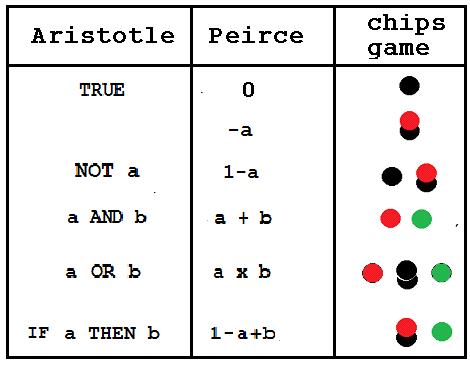
Now, we can construct an arithmologic game that simulates Boolean arithmetic by representing TRUE or 1 by black chip    and variables by colored chips. Other representations for logical expressions is shown in the following table
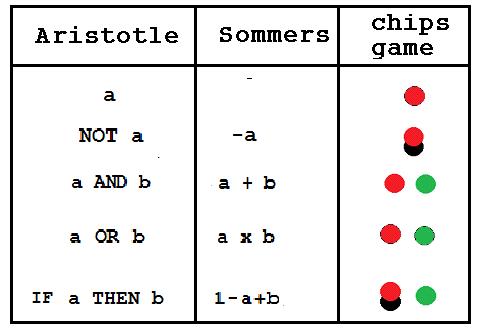
Sommersian logic table chips


The Categorical Proposition of Aristoteles

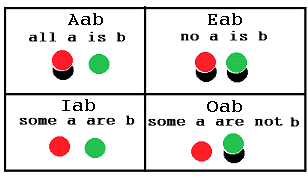
If a is represented by RED chip, b by a GREEN chip and 1 by a BLACK chip, the the four fundamental categoric proposition of Aristotle can be represented as it is shown in the following table.

Sommersian Aristotle chip.jpg

Simulating the Syllogism Validity Proof
Reasoning by syllogism now can be simulated by three steps algorithm
1. Combined all the representation of premises with AND as the combinator.
2. Dispose all chip pairs  where the red chip is the symbol of any colored chip.
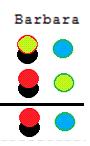
3. Read the rest as conclusion. If the rest is containing two color chips then the syllogism is valid. Otherwise it is invalid.

Proving Valid Syllogisms

To prove the Barbara syllogism, IF all m is p AND all s is m THEN all s is p, we represent s, m and p with red, green and blue chips and represent the conjunction of premises as the chips configuration above the horizontal line in the picture below.


Peircean Barbara Chips

By discarding opposite pairs of chips, we will get the chips configuration below the line which can be read as the conclusion of the syllogism.

The proof the validity of all 15 syllogisms can be derived with the help of the following table.


Sommersian syllogism table chip


Beside the 15 valid syllogisms without any assumption of the existence of a certain term, there are 9 valid moods of syllogism containing existential assumption.

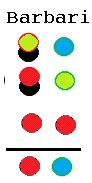
For example, the validity of Barbari syllogism which is containing one assumption of the existence of the subject term can be proven like this, where the the third proposition is Iss is represented by the following picture.
Peircean Barbari chips
In the proof, we just eliminate the oppositional pair of chips above the horizontal line to get the chip configuration below the line.

The proof the validity of all 9 existential syllogisms can be shown in the following table.

Sommersian existential syllogism table chip
Afternotes

The chips game can be used to prove hypothetical and disjunctive of the Stoic logician. In fact it can be used to prove any Boolean tautology. So it is shown that a game of concrete object can also simulate any logical proof in abstract algebraic symbols.

The objects chosen in this blog are colored chips. However the colored chips can be replaced with any objects and the black chips can be replaced with any sheets of paper. For example, the colored chips are replaced with colored marbles and the black chips are replaced with closed cards.

In this blog, logic is formulated with Sommersian algebraic symbols. The Boolean algebraic, Peircean pictorial and Sommersian literal formulations can also be simulated with similar game of concrete things. Among the three games, the Sommersian is the simplest.

All the logic games of concrete things are so easy to play that it can be taught to any kindergarten kid. Surely, we just teach them the rules of formation and transformation of the things arrangement without the logical interpretation.

Once they are skilled in the logic game playing, the algorithm will be deeply entrenched in their subconscious so it will facilitate their logical skill in later ages. Hopefully, the games can also enhanced their IQ like the WFF’n PROOF game created by professor Layman E. Allen in the Yale University.

Wednesday, August 12, 2015

Peircean Chips Game of Logic

Peircean Chips Game of Logic
Armahedi Mahzar © 2015


 https://upload.wikimedia.org/wikipedia/commons/thumb/a/a4/Charles_Sanders_Peirce_theb3558.jpg/200px-Charles_Sanders_Peirce_theb3558.jpg

In my previous blog I presented a simulation of Boolean arithmologic with a game of chips. In this blog I will show you how to simulate Peircean Arithmologic using the same chips. It will be shown that the derivation of the conclusion from two premises in the valid syllogisms is very easy. There are 24 valid syllogism as it is shown in the following Leibniz table:

Representing Logical Expression with Chips


Aristotle using verbal string of words to represent logical expression such as IF a THEN b. George Boole in 19th century used string of algebraic symbols to represent the mentioned logical expression as 1-a+b. In the 20th century, George Spencer-Brown used a containment of forms    to express the same logical expression as . Later, Louis Kauffman in his Box Algebra represent the same logical expression as  . Finally, I replaced Kauffman letters with colored chips, to get Object Logic algebra the representation of the logical expression IF a THEN b is  .
Now, we can construct an arithmologic game that simulates Boolean arithmetic by representing TRUE or 1 by black chip and variables by colored chips. Other representations for logical expressions is shown in the following table

Peircean Chips

The Categorical Proposition of Aristoteles

If a is represented by RED chip, b by a GREEN chip and 1 by a BLACK chip, the the four fundamental categoric proposition of Aristotle can be represented as it is shown in the following table.

Peircean Aristo chips

Simulating the Syllogism Validity Proof

Reasoning by syllogism now can be simulated by three steps algorithm
  1. Combined all the representation of premises with AND as the combinator.
  2. Dispose all chip pairs  where the red chip is the symbol of any colored chip.
  1. Read the rest as conclusion. If the rest is containing two color chips then the syllogism is valid. Otherwise it is invalid.

Proving Valid Syllogisms

To prove the Barbara syllogism, IF all m is p AND all s is m THEN all s is p, we represent s, m and p with red, green and blue chips and represent the conjunction of premises as the chips configuration above the horizontal line in the picture below.

Peircean Barbara Chips


By discarding opposite pairs of chips, we will get the chips configuration below the line which can be read as the conclusion of the syllogism.

The proof the validity of all 15 syllogisms can be derived with the help of the following table.
Peircean Syllogism chips

Beside the 15 valid syllogisms without any assumption of the existence of a certain term, there are 9 valid moods of syllogism containing existential assumption.

For example, the validity of Barbari syllogism which is containing one assumption of the existence of the subject term can be proven like this, where the the third proposition is Iss is represented by the following picture.
Peircean Barbari chips

In the proof, we just eliminate the oppositional pair off chips above the horizontal line to get the chip configuration below the line.

The proof the validity of all 9 existential syllogisms can be shown in the following table.

Peircean Existential syllogism chips

Afternotes

The chips game can be used to prove hypothetical and disjunctive of the Stoic logician. In fact it can be used to prove any Boolean tautology. So it is shown that a game of concrete objects can simulate any logical proof in abstract algebraic symbols.

The objects chosen in this blog are colored chips. However the colored chips can be replaced with any objects and the black chips can be replaced with any sheets of paper. For example, the colored chips are replaced with colored marbles and the black chips are replaced with closed cards.

In this blog, logic is formulated with Peircean algebraic symbols. However logic can also be represented Sommersian arithmetical symbols. Both Peircean pictorial and Sommersian literal formulations can also be simulated with similar game of concrete things. The new games is simpler than the Boolean game described before.

All the logic games of concrete things are so easy to play that it can be taught to any kindergarten kid. Surely, we just teach them the rules of formation and transformation of the things arrangement without the logical interpretation.

Once they skilled in the logic game playing, the algorithm will be deeply entrenched in their subconscious so it will facilitate their logical skill in later ages. Hopefully, the games can also enhanced their IQ like the Wff’n Proof game created by proessor Layman E. Allen in the Yale University.

Reblogged from https://integralisme.wordpress.com/2015/08/12/peircean-chips-game-of-logic/